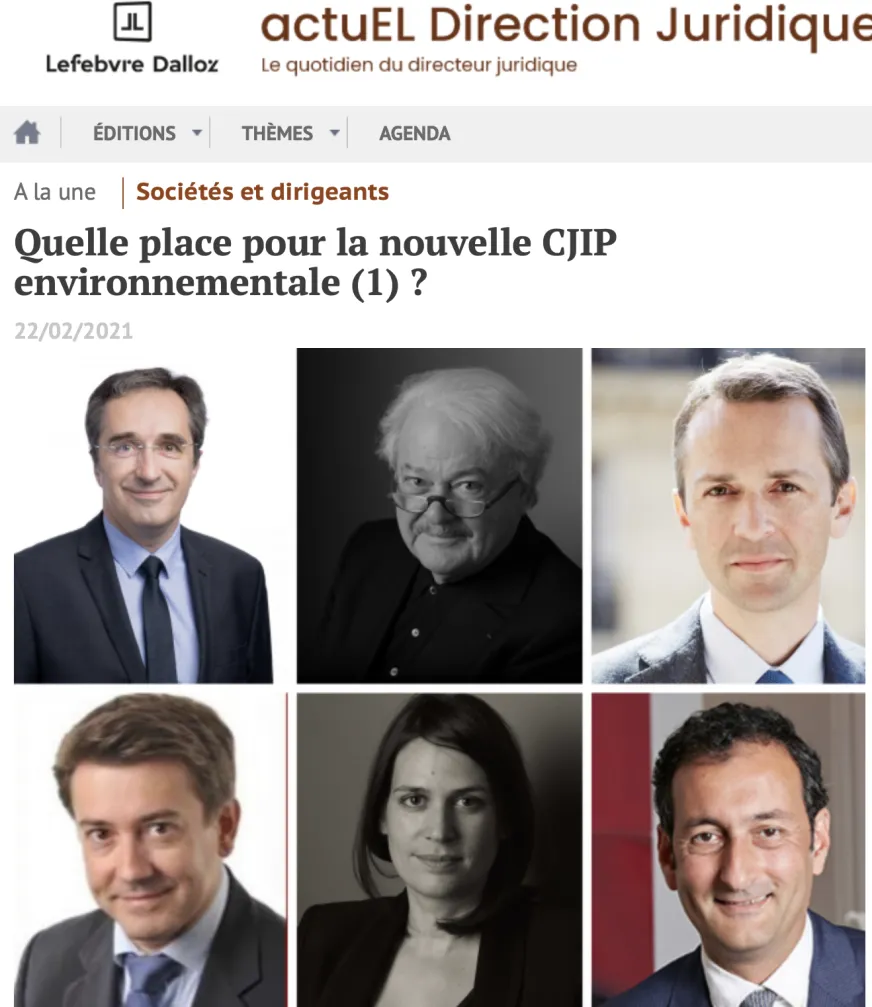
These interviews featured several attorneys specializing in different areas:
🔹 Daniel Soulez Larivière, founding attorney, Soulez-Larivière Avocats
🔹 Capucine Lanta de Bérard, criminal defense attorney and partner, Soulez-Larivière Avocats
🔹 Benoît Denis, of counsel, Huglo Lepage
🔹 Xavier Delassault, Director of the “Litigation Resolution” Department and the “Criminal Risk Prevention & Management” Network, Fidal
🔹 Antoine Carpentier, Partner, Fidal
🔹 Emmanuel Daoud, partner, Vigo
During these interviews, Capucine Lanta de Bérard and Daniel Soulez Larivière shared their perspectives as criminal defense attorneys on this new Judicial Agreement in the Public Interest (CJIP) for Environmental Matters—a promising tool, yet one with identified limitations—and called for a strengthening of the rights of the defense for individuals.
1. The Origins of the CJIP and the Legitimacy of Its Extension to Environmental Matters. Capucine Lanta de Bérard notes that the CJIP originated in the context of anti-corruption efforts to fill a gap: due to a lack of prosecutions in France—particularly in transnational cases—French companies were subject to U.S. extraterritorial proceedings. This mechanism enabled the French justice system to regain jurisdiction over these cases, and its extension to environmental matters is viewed positively. Daniel Soulez Larivière sees it as a timely response to the proliferation of criminal charges in France, allowing disputes to be resolved “without excessive criminal overreach.”
2. Conditions for Using the CJIP. This tool is not universal: it is not appropriate when the defense intends to resolve a matter of principle, as in Erika’s case, where the interpretation of international conventions was also at stake. Furthermore, the CJIP is a “one-shot solution”: its one-time nature limits abuse and makes it a means of settling a past that no longer corresponds to the company’s current situation.
3. The Role of Victims and Organizations. Capucine Lanta de Bérard defends the legislature’s decision not to involve civil parties in the negotiation of the public-interest fine: it is the role of the public prosecutor’s office to seek the penalty.
4. Procedural safeguards and the fate of individuals. This is the critical issue highlighted by both Capucine Lanta de Bérard and Daniel Soulez Larivière. When the procedure is initially based on the company’s internal investigation—sometimes without sufficient safeguards—the company can steer the case, at the risk of a criminal investigation that is, in a sense, “delegated.” Capucine Lanta de Bérard advocates for greater adversarial proceedings by utilizing the authority already provided for in preliminary investigations but rarely exercised by the public prosecutor’s office. Daniel Soulez Larivière broadens the discussion on the fate of individuals by citing the American example of the “fair trial.”