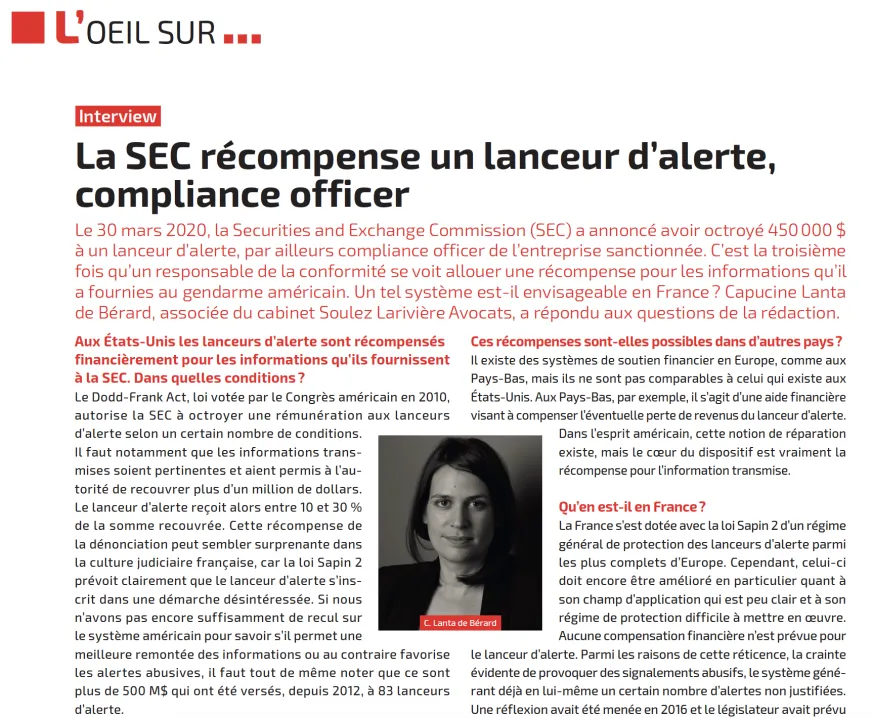
In the United States, the Dodd-Frank Act allows for the payment to a whistleblower of 10 to 30 percent of the amounts recovered in excess of $1 million. Since 2012, more than $500 million has been paid to 83 individuals. For compliance officers, the rules are stricter. The report must be necessary to prevent significant financial harm. The alert must first have been raised internally. Management must then have rejected it or failed to respond for 120 days.
In Europe, some countries, such as the Netherlands, have established support mechanisms. Their approach is different: they compensate for a loss of income, without rewarding the disclosure of information.
In France, the Sapin 2 Law offers some of the most comprehensive protection in Europe, but no financial compensation. Financial assistance to be provided by the Defender of Rights had been considered but was subsequently struck down by the Constitutional Council.
In conclusion, a U.S.-style financial incentive mechanism seems unlikely in France. However, a regulated form of assistance that compensates for lost income and enables whistleblowers to defend themselves would be worth reconsidering. Whistleblowers often remain financially vulnerable due to job loss or legal proceedings.