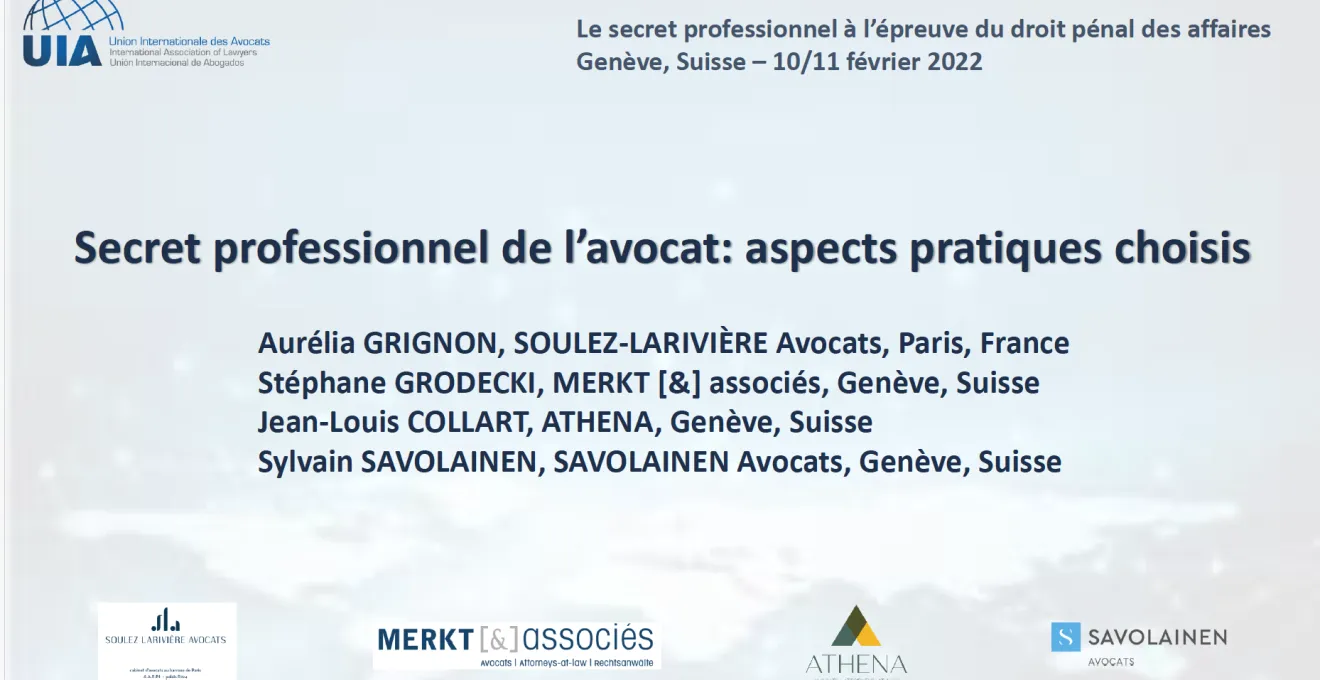
On February 10 and 11, 2022, the Criminal Law Commission of the International Union of Lawyers brought together French and Swiss attorneys in Geneva to discuss the topic: “Attorney-Client Privilege in the Context of Criminal Business Law.”
Aurélia Grignon represented the firm at the event as part of a panel titled “Attorney-Client Privilege: Selected Practical Aspects,” alongside three Geneva-based practitioners: Stéphane Grodecki (MERKT [&] associés), attorney, former Chief Prosecutor of the Geneva Public Prosecutor’s Office, and lecturer at the University of Geneva; Jean-Louis Collart (ATHENA), attorney and former President of the Geneva Bar Association; and Sylvain Savolainen (SAVOLAINEN Avocats).
Aurélia Grignon presented the French legal context, which is marked by a paradox:
Very broad confidentiality in theory. Article 66-5 of the 1971 Act covers, in all matters—whether advisory or defensive—consultations, correspondence, meeting notes, and case files.
A duty of confidentiality subject to criminal penalties for attorneys (Article 226-13 of the Penal Code).
But no true “right” to confidentiality vis-à-vis judicial authorities. Articles 56, 56-1, 76, and 97 of the Code of Criminal Procedure establish a balance between the protection of confidentiality and the effectiveness of prosecutions; however, the Criminal Chamber of the Court of Cassation’s interpretation of case law tends to establish that confidentiality is “unenforceable” against judicial authorities, particularly in criminal matters.
The seminar was held a few weeks after the adoption of Law No. 2021 -1729 of December 22, 2021, on confidence in the judicial system, which amended the preliminary article of the Code of Criminal Procedure to solemnly affirm that respect for the professional secrecy of the defense and legal counsel, as provided for in Article 66-5 of the 1971 Act, is guaranteed throughout criminal proceedings. It also amended the rules governing searches of a lawyer’s office or residence, effective as of March 1, 2022. However, this progress remains limited: attorney-client privilege yields to the imperatives of combating economic and financial crime, since the new Article 56-1-2 of the Code of Criminal Procedure provides for exceptions, particularly in cases of tax fraud and corruption.
The other speakers provided insights into Swiss law:
- Stéphane Grodecki outlined the distinction between a lawyer’s typical activities—which are covered by attorney-client privilege—and atypical activities. He emphasized that the protection of communications between the defendant and their defense counsel is absolute, but that it does not extend to the entirety of an internal investigation.
- Jean-Louis Collart addressed conflicts of interest and the prohibition on taking on new clients, as well as potential abuses of these rules.
- Sylvain Savolainen discussed the tension between attorney-client privilege and the justification of fee invoices when compensating the parties at the conclusion of criminal proceedings.
The firm is pleased to have been able to contribute to these Franco-Swiss discussions on a topic central to the practice of business criminal law.
More information is available on the UIA website: https://www.uianet.org/fr/evenements/le-secret-professionnel-a-lepreuve-du-droit-penal-des-affaires