Robert Badinter prize final

Eight candidates and a demanding challenge: to draft eight bills that remain true to the legacy of the man who made the law an instrument in the service of human dignity and freedoms. 

08 October 2026

Capucine Lanta de Bérard
Image
Les membres du Jury

Capucine Lanta de Bérard will serve tonight as a member of the jury for the final round of the Robert Badinter Prize, organized by the National Bar Council.


For this second edition, lawyers and law students took on a demanding challenge: drafting a bill that remains true to the legacy of the man who made the law an instrument in the service of human dignity and freedoms.


Congratulations in advance to the eight finalists who will compete tonight and present their draft bills. We look forward to hearing from you!


- Charles Culioli-Paoli (Paris & New York): guaranteeing the rights of the defense in the face of algorithmic evidence

- Romane Debelut (Montpellier): ensuring the right to higher education while in detention

- Gabrièle Gien (Paris): Establishing an enforceable right to a healthy environment

- Thomas Gruet (Nouméa): Strengthening procedural safeguards applicable to investigations into deaths that may be attributed to public officials

- Alexandre Minot-Chartier (Paris): Combating attacks on journalistic independence

- Arthur MOREL (Nîmes): Balancing the Development of Digital Technologies with the Protection of Human Dignity and Fundamental Freedoms

- Alice Poitevin (Vannes): Rethinking Correctional Facilities and the Detention System

- Lily Ravon (Paris): Combating Transnational Repression Targeting French Residents

hashtag#PrixRobertBadinter hashtag#CNB hashtag#Avocats hashtag#Justice hashtag#LibertésFondamentales hashtag#Dro

News

Presentation at the institute for criminal defense: “Invoking the exercise of a fundamental right”

Aurélia Grignon spoke at the Institut de Défense Pénale training session on fundamental freedoms, presenting the jurisprudential revolution in proportionality review and the opportunities it offers to the criminal defense bar.

27 June 2026

Aurélia Grignon
Image
IDP

Aurélia Grignon, a partner at the firm, spoke in Marseille at a training session organized by the Institut de Défense Pénale (IDP) titled “Fundamental Freedoms: The Never-Ending Struggle of Lawyers,” alongside Brice Grazzini, Yann Le Bras, David de Pas, Bertrand Périer, and Amélie Morineau.

Speaking on the topic of the “case law theory of proportionality review,” Aurélia Grignon began by outlining the revolution brought about over the past decade in this area by the Court of Cassation. Following the lead of the European Court of Human Rights (Axel Springer v. Germany, 2012; Eon v. France, 2013), the Court of Cassation no longer limits itself to an abstract review of whether laws comply with fundamental rights. It now verifies, in light of the circumstances of the case, that the application of the law does not constitute a disproportionate infringement of a fundamental freedom. In criminal matters, this review has led to the overturning of convictions for fraud, theft, vandalism, indecent exposure, or obstruction of traffic, in the name of freedom of expression (Article 10 of the Convention). The cases involving those who “tore down presidential portraits” and the Femen activists are the best-known examples of this. This new defense succeeds where the state of necessity failed.

She then took stock of this first decade of case law. The review always follows a two-part process: Is a fundamental freedom being infringed, and is that infringement disproportionate? When freedom of expression is at issue, the Court further requires a direct link between the conduct in question and a message of public interest. It assesses proportionality based on criteria that vary depending on the offense: the material and symbolic value of the property and the reversibility of the damage in cases of theft; and the extent of the disruptions and the conduct of both protesters and authorities in cases of obstruction of traffic. These criteria allow for some disparities, but they provide a valuable framework for analysis. Like the QPC or the preliminary ruling before it, the proportionality review is a defense tool that attorneys must learn to wield and extend beyond established precedents, drawing in particular on the case law of the European Court.

The firm would like to thank the Institut de Défense Pénale—a forum for exchange to which it is deeply committed—for its invitation and for the enriching experience of the day.

News

Participation in the CAVEAT symposium on the Lafarge case

Aurélia Grignon spoke at the roundtable discussion on the role of the civil party in criminal trials during the first symposium organized by CAVEAT on the Lafarge case, described as a “testing ground for issues in criminal justice” related to terrorism.

19 May 2026

Aurélia Grignon
Image
programme Caveat affaire Lafarge

Terrorism, criminal liability of legal entities, extraterritorial jurisdiction of French courts, and the role of victims: few cases involve as many issues as the Lafarge case. On May 19, 2026, CAVEAT and the Léon Duguit Research Center organized the first symposium dedicated to this case, bringing together academics and attorneys, including counsel for the defendants and representatives of civil parties. The event was under the academic direction of Emma Ruquet.

Aurélia Grignon spoke during the third roundtable discussion, which focused on the role of victims in criminal proceedings and was moderated by Sarah Marie, secretary general of CAVEAT. Alongside Caroline Lacroix, a professor at the University of Évry Paris-Saclay, and Rachel Lindon and Julie Février, counsel for the civil party organizations Yazda and Sherpa, Aurélia Grignon presented the defense’s position on the challenge to admissibility.

This presentation provided an opportunity to revisit the position of the Criminal Chamber of the Court of Cassation, which, in two rulings from 2021 and 2022, held that the financing of a terrorist enterprise is not likely to cause direct harm. It therefore ruled that certain associations and former Lafarge employees lacked standing.

The discussion then broadened to a more general reflection on how the issue of inadmissibility operates under our Code of Criminal Procedure. Since it cannot be resolved before the hearing, the issue of admissibility allows clearly inadmissible civil parties to weigh on the trial from start to finish. In a case as voluminous as that of Lafarge—which raises numerous unprecedented questions and was tried in barely five weeks—this limited trial time left little room for substantive debate. This is a difficulty that had already been noted in previous high-profile trials, one that French law has still not resolved.

The firm would like to thank the CAVEAT office and the symposium’s scientific director, Emma Ruquet, for organizing this event and for the rich discussions that took place.

For more information, visit the CAVEAT website: https://www.le-caveat.org/evenements

News

Presentation at the certificate in criminal law program at Aix-Marseille University

Aurélia Grignon spoke as part of the Certificate in Criminal Practice on the art of preparing and asking questions during a hearing, drawing in particular on insights from Anglo-Saxon cross-examination.

21 March 2026

Aurélia Grignon
Image
logo atelier pratique pénale

Aurélia Grignon, a partner at the firm, spoke as part of the University Certificate in Criminal Practice, organized by the Criminal Practice Workshop and ISPEC (Aix-Marseille University) for its sixth cohort.

This program is designed for attorneys, law students, and master’s students. It systematically addresses the situations faced by attorneys practicing criminal law through 60 hours of practical instruction spread over ten days, culminating in a certificate issued by the Faculty of Law at Aix-Marseille University. The program is structured around three modules: the fundamentals of criminal practice, the discussion of evidence, and criminal trials.

Aurélia Grignon spoke during the module on court proceedings, specifically on the day dedicated to criminal trials. Alongside Attorney Jean Boudot and Mr. Pascal Gand, president of the criminal division in Marseille, she led the workshop “Learning to Prepare and Ask Questions.” This session focused on the art of questioning each participant in the trial: the investigator, the witness, the opposing party, the expert, or one’s own client. The challenge lies in knowing how to identify one’s interlocutor and the objective of each question.

Aurélia Grignon discussed the benefits of Anglo-Saxon-style cross-examination, with a focus on questioning witnesses. This technique provides the defense with valuable tools for testing the reliability of testimony and ensuring that the hearing serves as the true forum for discussing the evidence.

The firm was represented by two members during the event: Capucine Lanta de Bérard, a partner, also spoke in the morning on criminal trials.

More information is available on the Atelier de Pratique Pénale website: https://www.atelier-pratique-penale.fr/fr/certificat-pratique-penal/le-programme-complet

News

Conference on the internal investigation

Pauline Dufourq spoke as part of a series of lectures organised by the UJA on the topic: internal investigations – a comparative perspective from the standpoints of labour and criminal law

19 March 2026

Pauline Dufourq
Image
Enquête interne

News

2025 Criminal defense lawyers' day in Paris: Defending “the close bond with others”

On Friday, October 24, 2025, Capucine Lanta de Bérard spoke at “La Journée des Pénalistes,” an event dedicated to the book *Défendre* (published by Odile Jacob). This training session was offered by the Criminal Practice Workshop and organized by the EFB in partnership with the Paris Bar Association’s Institute of Criminal Law, ADAP, and the Institute of Criminal Defense. It took place in the Auditorium of the Maison du Barreau.

28 October 2025

Capucine Lanta de Bérard
Image
JDP 2025 Paris

Criminal Defense Lawyers’ Day 2025, centered on “Defending” (published by Odile Jacob).

A day of rich and valuable discussions among criminal defense attorneys about what defines our identity and the tools we use to defend our clients in these uncertain times.

12 chapters, reimagined by their authors. 

Capucine Lanta de Bérard spoke on “the close bond with others” alongside Jean Boudot Bruno Rebstock Christophe Bass Matthieu Boissavy Vincent Nioré Romain Boulet Daphné Belot François Saint-Pierre Gilles Accomando FAYOLLE ASSOCIÉS

Excerpt from Christophe Bass’s remarks on breaches of attorney-client privilege: à revoir sans modération


Image
JDP brochette de pénalisées

News

Conference marking the 20th anniversary of the European Arrest Warrant

Pauline Dufourq spoke at a conference organised by the University of Bordeaux on the procedure for executing a European arrest warrant.

22 November 2024

Pauline Dufourq
Image
Mandat d'arrêt européen

News

Criminal law day: Advocating: the body as a tool for expression

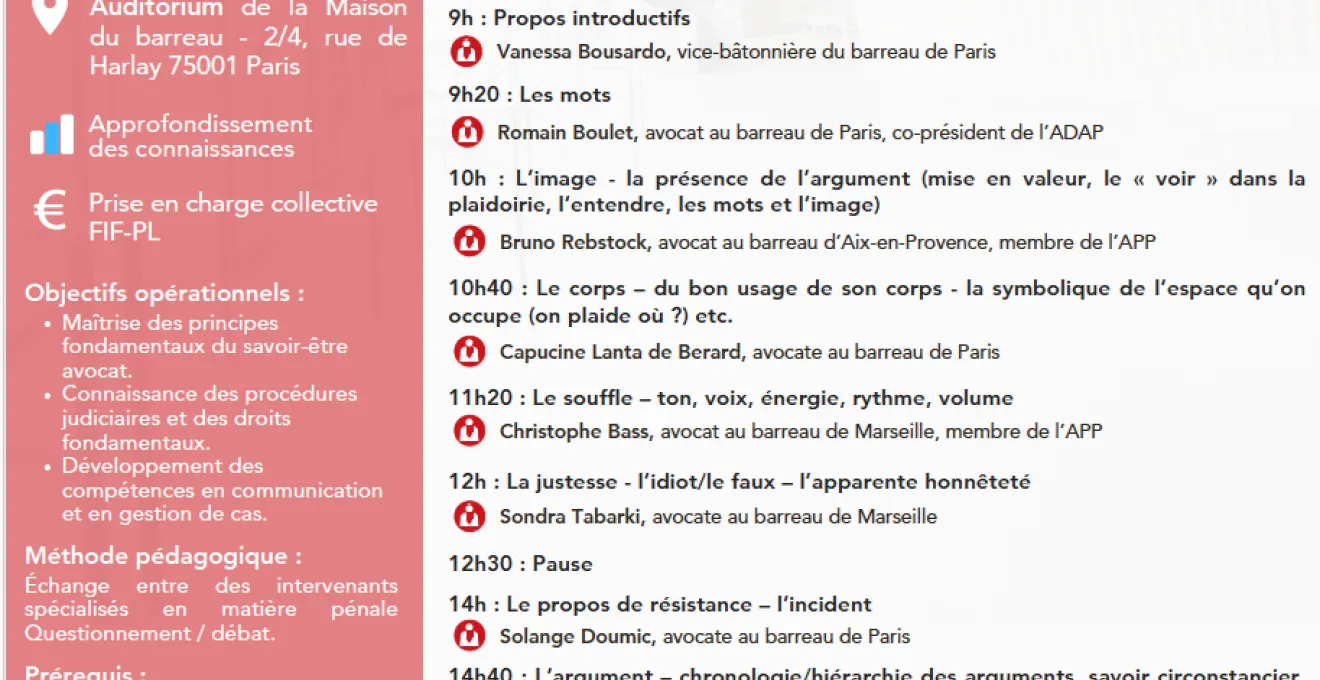
On Friday, October 25, 2024, Capucine Lanta de Bérard spoke at La Journée des Pénalistes, an event dedicated to “Plaider”—a training session focused on the tools and techniques for crafting and delivering courtroom arguments. This training session was offered by the Atelier de Pratique pénale and organized by the EFB in partnership with the Paris Bar Association’s Institute of Criminal Law, ADAP, and the Institute of Criminal Defense. It was held in the Auditorium of the Maison du Barreau.

28 October 2024

Capucine Lanta de Bérard
Image
JDP 2024 CLB

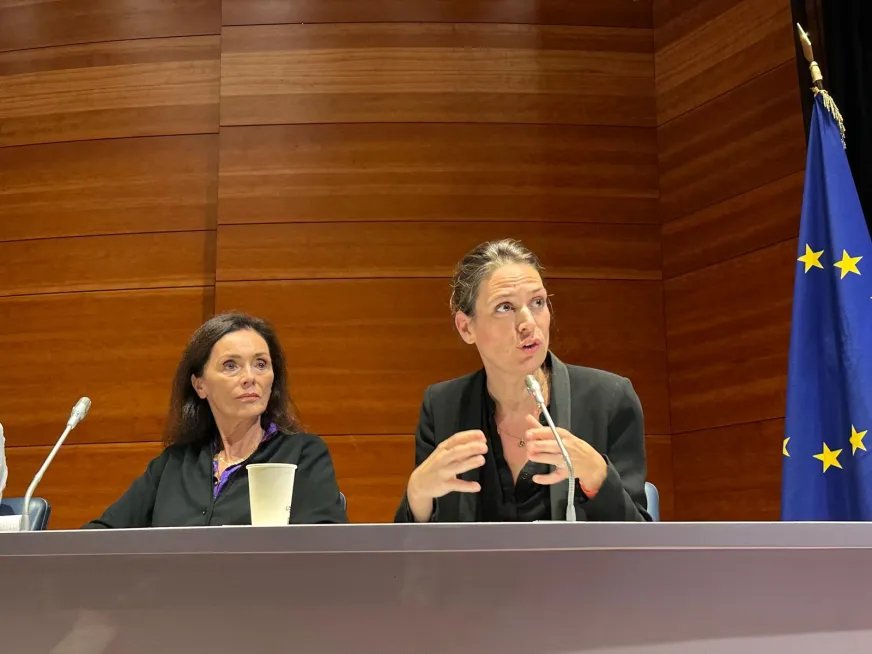
Capucine Lanta de Bérard spoke on the topic “The Body: The Proper Use of One’s Body and the Symbolism of the Space One Occupies”. She addressed a question that every criminal defense attorney asks themselves in court without always articulating it: Where do we argue our case, and what does our physical presence convey even before our words?

The event, moderated by Jean Boudot (Marseille and Paris Bar Associations), featured the following speakers:

🔹 Vanessa Bousardo, Vice President of the Paris Bar Association: opening remarks
🔹 Romain Boulet (Paris): words
🔹 Bruno Rebstock (Aix-en-Provence): the image and presence of the argument
🔹 Capucine Lanta de Bérard (Paris): the body
🔹 Christophe Bass (Marseille): the breath
🔹 Sondra Tabarki (Marseille): accuracy
🔹 Solange Doumic (Paris): The Discourse of Resistance and the Incident
🔹 Jacqueline Laffont (Paris): The Argument
🔹 Denis Fayolle (Marseille and Paris): Adapting to the Audience
🔹 Matthieu Boissavy (Paris): The Legal Framework of the Closing Argument
🔹 Philippe Vouland (Marseille): beginning and ending
🔹 Gilles Accomando, Director of the EFB: closing remarks

The Soulez Larivière law firm thanks the organizers for their invitation and all the speakers for their insightful discussions.

#CriminalLaw #OralArguments #Lawyers #ContinuingEducation #EFB #ParisBarAssociation
Image
JDP 2024 Paris
Image
JDP 2024

News

Participation in the Foncsi workshop-debate titled “The judicialization of deviations from regulated standards”

Aurélia Grignon discussed, alongside representatives from Airbus and MACSF, how the criminal justice system assesses violations of safety rules following an accident. The discussion has been published in *Cahiers de la Sécurité Industrielle*.

17 September 2024

Aurélia Grignon
Image
programme FONCSI 2024

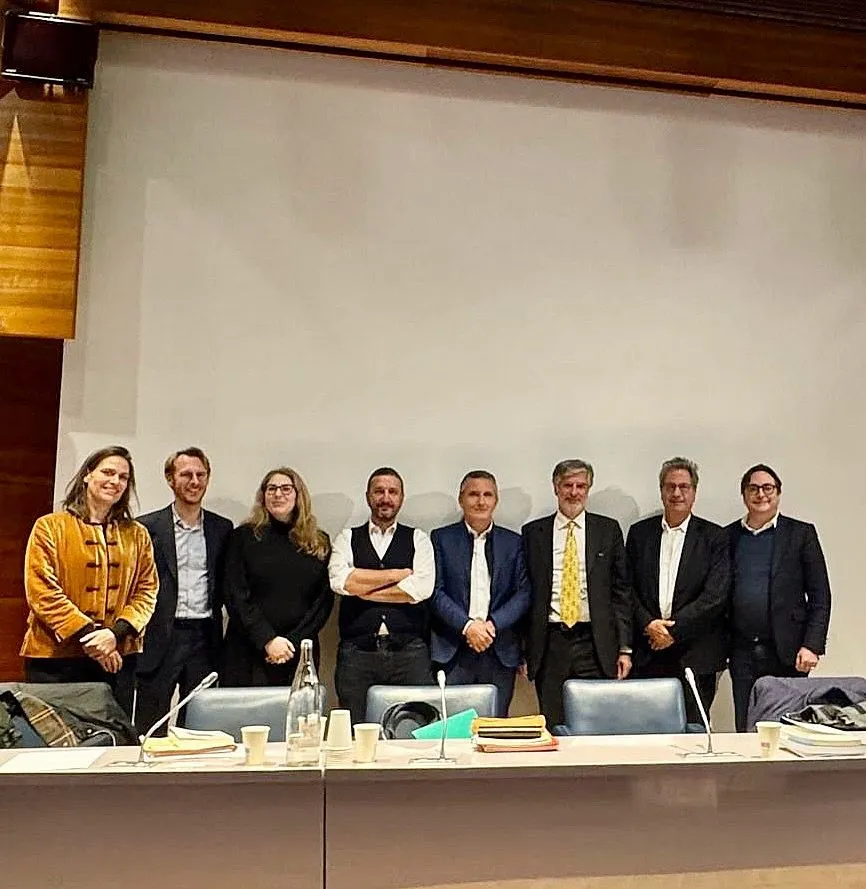
Aurélia Grignon, managing partner of the firm, spoke on September 17, 2024, at an online workshop and discussion organized by the Foundation for a Culture of Industrial Safety (Foncsi). She participated in a discussion with Nicolas Gombault, deputy CEO of the MACSF insurance group, and Yannick Malinge, Head of Airbus Aviation Safety. Pierre-Franck Chevet, CEO of IFP Énergies Nouvelles, moderated the discussion.

The workshop’s theme was as follows: in post-accident investigations, the justice system tends to view culpability as greater the larger the deviation from the standard, treating this standard as an algorithm to be followed rather than as a guide. The speakers discussed the extent to which the judicial system is able to move away from the “deviation → culpability” principle, and what the consequences are for professionals and companies.

Drawing on her experience with major industrial disaster and aviation accident cases, Aurélia Grignon outlined several observations:

🔹 The pressure to find a culprit. In major disasters, public sentiment puts pressure on the judicial system to identify someone responsible. In France, the justice system tends to systematically criminalize accidents—even in the absence of proven regulatory violations—by relying on the less clearly defined concepts of “negligence” and/or “gross negligence.”

🔹 Due diligence: A Limit to the “Deviation = Guilt” Principle. Article 121-3 of the Penal Code requires that due diligence be assessed based on the specific circumstances and the information available at the time of the decision. This argument has led to acquittals, notably in the Concorde case, but often only after very lengthy proceedings.

🔹 A counterproductive effect on safety. Legal action may deter stakeholders from reporting anomalies, even though feedback is essential for the continuous improvement of safety.

🔹 The need for a framework. Aurélia Grignon noted, however, that legal certainty requires a clear framework for assessing violations. Change is possible, but it must come from the professionals themselves, who are best positioned to define appropriate behavior when faced with the unexpected.

The firm is pleased to have been able to share its experience in criminal law related to accidents and disasters in this dialogue between the judicial and industrial safety communities.

The transcript of the debate is published in the *Cahiers de la Sécurité Industrielle* (No. 2024-10) and is available on the Foncsi website : https://www.foncsi.org/publications/judiciarisation-ecarts-referentiel-regle. 

Image
programme FONCSI 2024

News

Court of Cassation - Symposium: “The many faces of negligence: from definitions to manifestations.”

Capucine Lanta de Bérard spoke at the roundtable discussion on negligence in environmental criminal law.

Image
Chambre criminelle

On April 21, 2023, the Criminal Chamber of the Court of Cassation and the Institute of Criminology at Paris-Panthéon-Assas University (ICP) organized a symposium on “The Many Faces of Negligence: From Definitions to Manifestations.”

Professor Yves Mayaud, Professor Audrey Darsonville, Professor Marthe Bouchet, and Benjamin Joly, Referendary Counselor at the Court of Cassation, enriched the morning session with their insights on topics that are as essential as they are fascinating:

  • Should Negligence Be Punished? – A Criminological and Criminal Policy Approach
  • Certainty and Variations in Causality
  • The Degrees of Negligence
  • From Concepts to Assessment: The Role of the Criminal Chamber in Cases of Negligence

The conference continued in the afternoon with three panel discussions focusing on manifestations of negligence in medical criminal law, labor criminal law, and environmental criminal law, a roundtable discussion in which Capucine Lanta de Bérard, a partner at the firm, participated alongside Jean-Louis Croizier, Advocate General at the Court of Cassation, and Isabelle Goanvic, Justice of the Court of Cassation.


This was also an opportunity for Capucine Lanta de Bérard to reflect on the work of the Multidisciplinary Working Group on Environmental Criminal Law, of which she was a member. The group was chaired by Mr. François Molins, Prosecutor General at the Court of Cassation, and its report was submitted on December 7, 2022.
The firm extends special thanks to Professor Didier Rebut for his invitation, as well as to Professor François Guy Trébulle for chairing and coordinating this roundtable and facilitating fruitful discussions before, during, and even after the event.

https://www.courdecassation.fr/agenda-evenementiel/les-visages-de-la-faute-dimprudence-des-contours-lexpression

News